
Where is the pickup with plate AB-CD-12 right now? What trips did truck 12 make yesterday? Once you connect Atlas to ChatGPT, you can ask the assistant those questions and it answers with your fleet's data, using your own Atlas account. There's nothing to install and nothing to request from UGPS: you set it up in a few minutes from ChatGPT.
The screenshots in this guide show ChatGPT in Spanish. In English, the buttons are in the same places.
What you need
- Your Atlas account, the same one you use to sign in to the platform.
- ChatGPT on the web (chatgpt.com). The screenshots in this guide come from an account on the free plan.
- The Atlas server address, which is always the same:
https://mcp.ugps.io/mcp
If you use ChatGPT in your company's workspace (Business or Enterprise), its permissions decide whether you can add custom MCP servers. If you don't see the option, ask your admin.
Step 1: open Plugins and add an MCP server
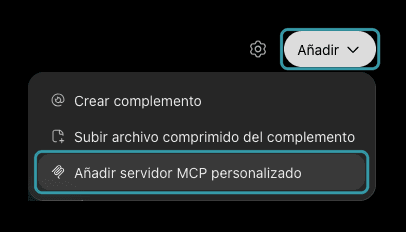
In the ChatGPT sidebar, go to Plugins (or open chatgpt.com/plugins). At the top right, tap Add and choose Add custom MCP server.
Step 2: fill in the form
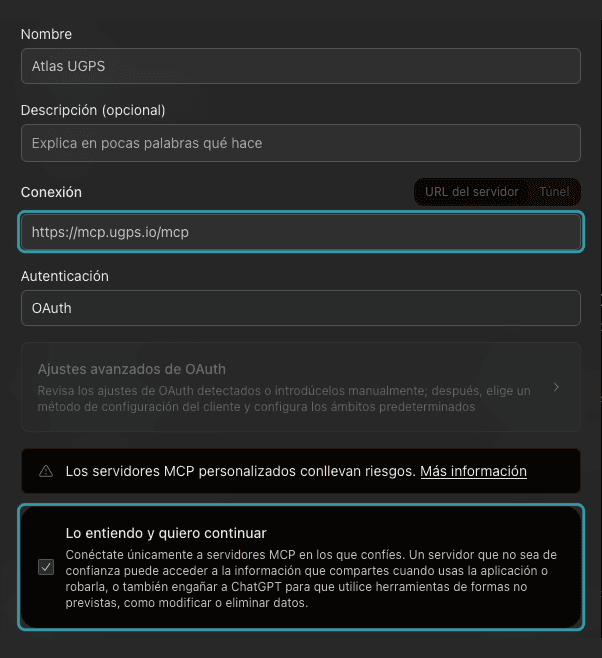
- Name: one you'll recognize, for example Atlas UGPS. The description and the icon are optional.
- Connection: keep Server URL selected and paste
https://mcp.ugps.io/mcp. - Authentication: ChatGPT detects on its own that Atlas uses OAuth. Don't change anything or open the advanced settings.
ChatGPT asks you to only connect to MCP servers you trust. Atlas is the UGPS server: check I understand and want to continue and tap Create as a plugin.
Step 3: connect your Atlas account
ChatGPT explains what data it shares with the plugin. Tap Connect Atlas UGPS.
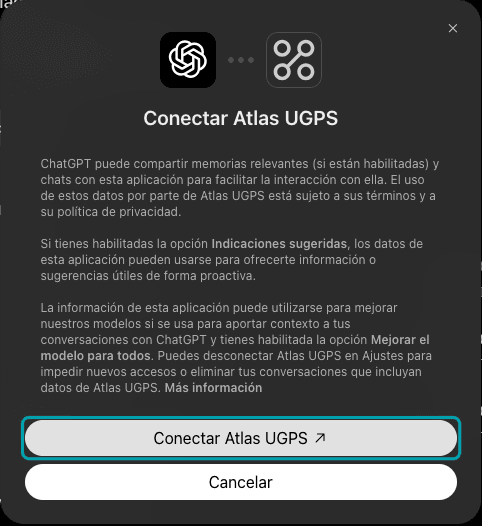
An Atlas window opens. Enter your Atlas email and password and continue. If your account uses two-step verification, enter the six-digit code you get by email. When you're done, the window takes you back to ChatGPT.
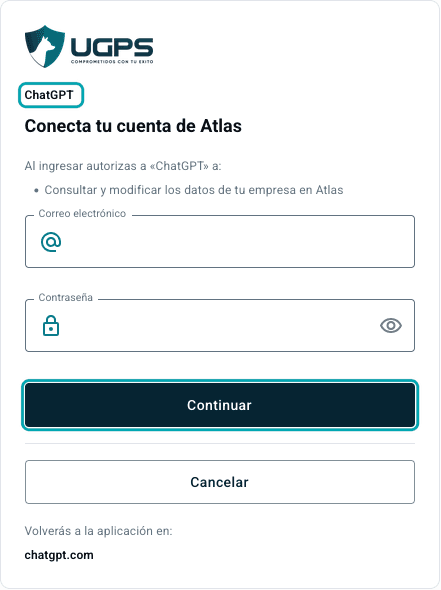
Only sign in if the window names ChatGPT, the assistant you're setting up. If that screen shows up and you didn't start a connection, cancel it.
Step 4: check that it's installed
Back in Plugins, search for “Atlas” and you'll see the plugin with the name you gave it.
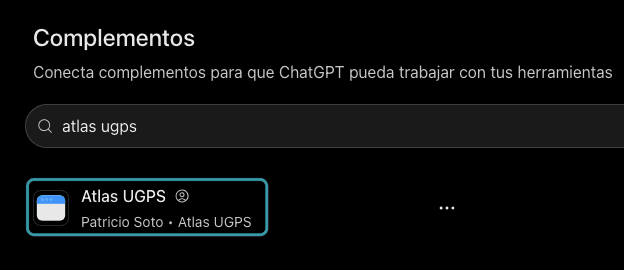
Step 5: ask your first question
Open a new conversation, type @ in the message box and choose Atlas UGPS. Then ask the way you'd ask someone on your team. When the question is about your fleet, ChatGPT can also query Atlas on its own.
- “Which vehicles are moving right now?”
- “How many kilometers did the fleet drive this week?”
- “Were there any speeding alerts this week?”
- “How many times did truck 12 enter the central warehouse this month?”
- “Which field tasks are still pending today?”
If you don't know where to start, ask it “What can you do with Atlas?”
Good to know
- It reads and it also makes changes. It can do the same things you do in Atlas, with your role's permissions. By default, ChatGPT asks you to approve every action that changes data, and Atlas asks you to confirm before deleting anything, sending something to other people, changing access or making bulk changes. It can't trigger a device's outputs, such as the engine cut-off (what it can do, in Spanish).
- It sees what you see. It only answers with the vehicles, groups and data your user can access. Each person in your company connects their own account.
- The connection lasts up to 30 days. When it expires, ChatGPT asks you to authorize it again (Atlas guide, in Spanish).
- No extra cost. Connecting Atlas is free.
- Your data in ChatGPT. What Atlas answers stays in your conversation. If Improve the model for everyone is on in your account, OpenAI can use those conversations to train its models. You can turn it off in Settings, Data controls.
- Disconnect whenever you want. In Settings, go to Plugins, open Atlas UGPS and disconnect it. If you think someone else connected an assistant with your account, change your Atlas password and let UGPS support know.
Do you use Claude? You can also connect Atlas to Claude. The full guide, Codex included, is in the Atlas documentation, in Spanish. If you have questions while connecting, write to us.